Soy protein—particularly its amino acid content—is used in the manufacture of gardenia blue dye to provide the nitrogen-rich compounds necessary for the color-forming reaction. Here's a detailed explanation of its role in the production of gardenia blue, extracted from the fruit of Gardenia jasminoides:
What Is Gardenia Blue?
Gardenia blue is a natural blue pigment formed from a chemical reaction involving geniposide, a compound found in gardenia fruit, and amino acids or proteins. Geniposide is hydrolyzed into genipin (usually with the enzyme β-glucosidase); genipin then reacts with primary amino groups, and the products polymerize into blue pigments.
Gardenia yellow is a different color made from the same fruit. Its pigments are crocin and crocetin (carotenoids, the same pigment type as in saffron), and it is not made by reacting with soy protein.
Role of Soy Protein in Gardenia Blue Production
1. Source of Amino Groups
- Soy protein (in the US product, soy protein hydrolysate) is used as a rich source of free amino groups.
- Genipin reacts with primary amine groups (–NH2), mainly on lysine side chains and at the N-terminal ends of peptides, and the products link together into deep-blue polymers.
2. Reaction with Genipin
- The gardenia fruit extract is treated, typically with the enzyme β-glucosidase, to convert geniposide to genipin.
- Soy protein or hydrolyzed soy protein is then added to the genipin solution.
- The amine groups in soy protein attack genipin’s ring and form nitrogen-containing ring compounds; in the presence of oxygen these polymerize into stable blue pigments.
The reaction is sometimes compared with Maillard browning, because both join a reactive small molecule to amino groups, but the chemistry is different and no sugar is involved.
Process Summary: Gardenia Blue with Soy Protein
Ingredients:
- Gardenia fruit extract (rich in geniposide)
- Enzyme (typically β-glucosidase) to hydrolyze geniposide to genipin
- Soy protein isolate, hydrolyzed soy protein, or soy peptides
- Water
- Buffer or mild base (e.g., sodium bicarbonate) to adjust pH to 7–8
Steps:
- Extract geniposide from crushed gardenia fruit using hot water.
- Hydrolyze geniposide, typically with the enzyme β-glucosidase, to form genipin.
- Add soy protein or hydrolysate to the genipin-rich solution.
- Maintain a temperature of ~40–50°C and pH 7–8 to promote reaction.
- Allow the reaction to proceed, during which the solution turns blue as cross-linked pigments form.
- Filter and dry (e.g., via spray drying) to create a stable blue powder.
Composition of Final Gardenia Blue Product (Soy-Based)
| Component | Function |
|---|---|
| Crosslinked genipin–soy pigment | Colorant (gardenia blue) |
| Residual soy protein and peptides | Not inert for allergic people: this is soy allergen, and the reason soy must be declared on US labels |
| Polysaccharides from gardenia | Stabilizers |
| Moisture | ~5–10% |
| Carriers (optional) | Maltodextrin or dextrin to enhance flowability |
Why Soy Protein Is Used
- Soy protein hydrolysate supplies many free amino groups (mainly lysine side chains and the ends of peptides), which genipin needs to form a strong blue color.
- It is a widely available food ingredient — but soy is also one of the nine major food allergens in the US.
Allergen Warning
- Gardenia blue made with soy contains soy allergen. Soy protein and peptides left in the color are not inert: for a soy-allergic person they are the allergen. In the US, foods colored with gardenia (genipin) blue must declare soy.
Chemical Diagram of the Genipin–Soy Amine Crosslinking Reaction (Gardenia Blue Formation)
Step-by-Step Reaction Summary
A. Hydrolysis of Geniposide (from Gardenia fruit):

B. Reaction with Soy Protein (Amino Groups):

Simplified Chemical Reaction:
Genipin (an iridoid aglycone) reacts with free primary amino groups (–NH2), mainly lysine side chains and the N-terminal ends of soy peptides.
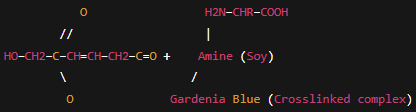
- The amine opens genipin’s ring and forms a nitrogen-containing ring compound; these units then polymerize in the presence of oxygen, giving the blue chromophore.
- Color intensity depends on the amino acid composition and concentration.
Regulatory Summary of Gardenia Blue (Soy-Derived) as a Food Colorant
| Region | Regulatory Status | Notes |
|---|---|---|
| USA (FDA) | Approved (2025) | Listed as gardenia (genipin) blue, 21 CFR 73.168, exempt from certification. The FDA order was published July 15, 2025 and took effect August 29, 2025. Permitted in sports drinks, flavored or enhanced non-carbonated water, fruit drinks and ades, ready-to-drink teas, and hard and soft candy. Made with soy protein hydrolysate, so soy must be declared. |
| China | Approved | Used in confections, beverages, and noodles. |
| Japan | Approved | Listed as a natural colorant on Japan’s List of Existing Food Additives. |
| South Korea | Approved | Used in traditional and modern food products. |
| EU | Not approved | Gardenia blue is not on the EU list of permitted food colors. |
| Cosmetics | Permitted in some cosmetic formulations | Gardenia ingredients appear under INCI names such as Gardenia Florida Fruit Extract. |
Allergen and Labeling Considerations
- Soy labeling is required in the US. Because gardenia (genipin) blue is made with soy protein hydrolysate, foods colored with it must declare soy, for example in a "Contains: Soy" statement.
- A petition filed in 2022 asks the FDA to exempt gardenia blue from soy allergen labeling. It is still pending; until the FDA acts, the soy declaration is required.
- Color additives that are exempt from certification may be listed by a general term such as "color added" rather than by name, so the soy declaration may be the clearest sign that gardenia blue is present.
- If you are allergic to soy, treat foods colored with gardenia blue as containing soy unless your allergist advises otherwise.
- In the EU, Regulation (EU) No 1169/2011 requires any ingredient derived from soy to be declared; other countries have their own allergen rules.